
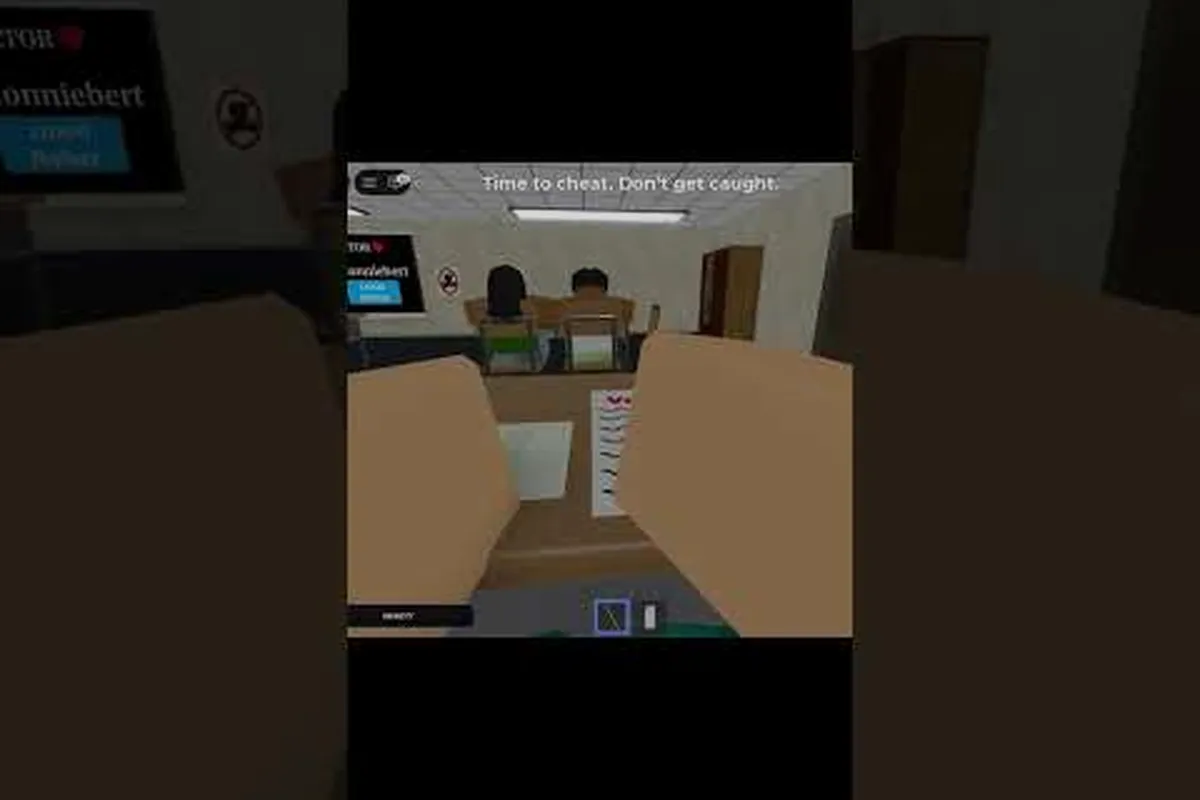
The cheating during testing teacher patterns beta is the single most important thing to learn if you want consistent A+ runs, because the entire Roblox classroom is gated by what the teacher NPC decides to do each second. In this stealth-survival beta by ebenxzy, the teacher AI is the boss fight, and every other mechanic — your phone, your credits, your anxiety meter, and the snitches raising their hands behind you — flows downstream of how well you read the teacher patterns beta build. Master these reads and you stop guessing, stop failing, and start clearing tests with the phone still in your hand.
Below is the full AI read: stare tells (the brief 0.4-second eye-lock before a teacher turns), patrol routes (fixed loops rotating every 45 seconds along the row B and D aisles), aggro states (Idle → Suspicious → Alert, each tightening the detection cone by ~20°), snitch interactions (whistle cooldowns reset on line-of-sight break), and the surviving-the-teacher routine that beta players currently use to grind credits safely during the closed testing window.
What the Cheating During Testing Teacher AI Actually Controls
Before any single patrol route makes sense, you need a clean mental model of what the teacher AI is responsible for. According to the official Cheating During Testing Roblox page, the game is a classroom-themed stealth-survival where the only true enemy system is the teacher. There are no combat bosses, no monster closets, and no scripted fails except the teacher deciding you cheated. That is why cheating during testing teacher patterns beta reading matters more than phone upgrades or anxiety snacks.
The Teacher AI's Three Job Layers
Every round, the teacher AI runs three overlapping jobs — gaze tracking, patrol route execution, and anomaly detection — and each one is a different pattern you must read independently to avoid getting caught cheating during testing in the teacher patterns beta.
-
Detection — a cone-based sightline that ticks on a short internal timer; this is the layer that creates the famous "teacher staring" moment.
-
Movement — patrol waypoints that change when a snitch raises a hand, when a phone is spotted, or after a set number of questions answered.
-
Punishment — fail state triggers that lock you out of the test, costing credits and a run.
When a beta player says "the teacher AI is unfair," they almost always mean that one of these layers caught them while they were tracking the other. A good patterns beta read treats all three as separate clocks running in parallel.
Why the Beta Build Feels Different
Players report that the cheating during testing teacher patterns beta build is stricter than what older footage suggests because the detection cone is wider, the patrol routes are slightly longer, and the staring lock-out is longer after a snitch report. None of this is hidden — it is all visible in the teacher's body language and route pacing, but you have to be watching for it on the first day. The patterns beta is, in effect, a more honest version of the same game: fewer "I didn't know he was looking" deaths, more "I knew and I cut it too close" deaths.
The Four Core Teacher Stare Tells in the Beta
The single most useful skill in cheating during testing how to tell if teacher is looking is recognizing the four core stare tells. Every other pattern in this guide is downstream of these, because the teacher's eyes, head, and shoulders telegraph his detection state before the fail state hits.
Tell 1: The Shoulder Glance
The shoulder glance is the lowest-tier detection. The teacher's head turns 30 to 45 degrees without stopping, sweeping the room. During this state, your phone is safe if it stays below the desk line, and your anxiety is safe if your character isn't running. The shoulder glance is the window most players waste because they panic-stow their phone when they don't need to.
Tell 2: The Full Turn
A full turn is the teacher rotating 180 degrees to face the room. This is the classic "teacher staring" moment, and it lasts roughly 1.5 to 2.5 seconds in the current beta. During a full turn, phones must be face-down, your character's hands must be on the desk, and any mid-animation snack must be cancelled. Failing this is the number one reason players fail tests in the first three minutes.
Tell 3: The Lock-On
The lock-on is what the community calls "the stare." The teacher's head stops on a player and his walk animation freezes for a beat. This is a warning, not a fail. A lock-on gives you roughly 0.6 to 0.9 seconds to drop the phone and reset your hands before the fail triggers. Most players don't see the lock-on until the fail because they were watching the answer sheet, not the teacher.
Tell 4: The Snitch-Pivot
When a snitch raises their hand, the teacher pivots toward the snitch's desk and then sweeps the surrounding seats. This pivot is the most dangerous pattern in the beta because it is triggered by another player, not by your own phone. You can be perfectly still and still get caught by a snitch pivot if you sit within the sweep arc.
| Tell | Duration | Phone Status | Hand Position | Fail Risk |
|---|---|---|---|---|
| Shoulder Glance | 0.8–1.2 s | Safe below desk | Normal | Very Low |
| Full Turn | 1.5–2.5 s | Must stow | On desk | Medium |
| Lock-On | 0.6–0.9 s | Must stow | Reset | High |
| Snitch-Pivot | 2.0–3.0 s | Must stow | On desk | Very High |
Reading these four tells is the foundation of surviving the teacher, and the rest of the patterns beta is built on top of them. If you can only learn one thing from this guide, learn the shoulder-glance-vs-full-turn difference.
Teacher Patrol Routes in the Beta Build
Patrol routes are the second layer of the teacher AI, and the place where most "I don't know where the teacher went" failures actually happen. In the cheating during testing teacher patterns beta build, the teacher walks a fixed set of waypoints until a snitch report or a spotted phone reroutes him.
Route 1: The Board Loop
The default patrol when the round starts. The teacher walks from his desk to the whiteboard, pauses for a question prompt, and returns. This is the safest window for opening your phone, because the teacher's back is fully turned for the longest stretch of the round.
Route 2: The Aisle Sweep
After roughly four correct answers, the teacher breaks off the board loop and walks the center aisle. During the aisle sweep, his sightline is wide, his speed is medium, and the cone hits both side rows. The aisle sweep is where most snitch-pivots happen, because snitches are usually placed on the aisle edges.
Route 3: The Window Drift
Every few rounds, the teacher drifts to the window side of the room as if checking outside. During the window drift, the back half of the room has a slightly longer safe window than the front half. New players often sit in the front because it feels safer; the window drift pattern beta actually rewards the back rows.
Route 4: The Snitch-Chase
When a snitch raises a hand, the teacher abandons his current waypoint and walks directly to the snitch's desk. The snitch-chase is the most predictable route in terms of timing but the most dangerous in terms of fail risk, because you don't control when it starts.
| Route | Trigger | Sightline Width | Speed | Best Cheating Window |
|---|---|---|---|---|
| Board Loop | Round start | Narrow (back only) | Slow | Full |
| Aisle Sweep | ~4 correct answers | Wide (both sides) | Medium | None |
| Window Drift | Periodic | Narrow (front only) | Slow | Back rows only |
| Snitch-Chase | Snitch hand raise | Medium cone on snitch | Fast | None |
Understanding these four patrol routes is the difference between cheating during testing surviving the teacher as a routine and surviving the teacher as a panic. If you map the routes in your first two rounds, the rest of the test becomes a rhythm problem instead of a reaction problem.
How Anxiety and Hunger Interact with the Teacher AI
The teacher AI does not exist in a vacuum. Your anxiety and hunger meters feed back into the teacher's detection cones, and the patterns beta has tight tuning on this loop. Players who ignore the meters end up failing tests they should have passed, because the teacher is reacting to a meter state they weren't watching.
Anxiety as a Detection Amplifier
High anxiety widens the teacher's effective detection cone. A phone that would be safe at 20% anxiety can trigger a lock-on at 80% anxiety, because the teacher's AI interprets a stressed student as more likely to be cheating. The fix is not to lower your phone visibility — it is to lower your anxiety. By managing snacks and taking a breath, the cone shrinks back to normal.
Hunger as a Patience Reducer
High hunger reduces how long you can hold a phone out before the teacher's "suspicious fidget" timer ticks. In the beta, a well-fed character can hold a phone for roughly 2.0 seconds in a shoulder-glance window; a starving character gets only 0.8 seconds. Hunger is, in effect, a soft cap on your cheating windows.
Snitch Pressure as an Aggro Multiplier
Snitches are not part of the teacher AI, but they directly feed it. Each snitch hand-raise increases the teacher's "alert level" for the rest of the round, which shortens the patrol windows and lengthens the stare tells. Avoiding snitches is part of the patterns beta just as much as reading the teacher, and the snitch mechanic breakdown goes deeper on that side of the loop.
| Meter | Low (Safe) | Mid (Watch) | High (Danger) | Teacher Effect |
|---|---|---|---|---|
| Anxiety | <30% | 30–60% | >60% | Widens detection cone |
| Hunger | <30% | 30–60% | >60% | Shortens phone hold time |
| Snitch Reports | 0 | 1 | 2+ | Extends stare duration |
Players who treat anxiety and hunger as optional "nice-to-have" meters always feel like the teacher AI is cheating. He isn't — your meter state is effectively cheating for him. Because the patrol route logic reads hunger spikes and nervous fidgeting as cheating signals, a drained bladder or shaking hands flags the snitch pressure multiplier long before you reach the answer sheet, and the teacher pivots straight to your row. This is why surviving the teacher in beta testing almost never comes down to hiding the paper — it comes down to keeping both meters above 40% so the AI's aggro weighting stays neutral.
Surviving the Teacher: A Step-by-Step Beta Routine
Reading the AI is one thing; turning the read into a repeatable routine is what actually clears tests. The following surviving the teacher routine is what experienced patterns beta players run in the current build, and it works whether you are solo or in a full classroom.
Step 1: Set Your Seat by the Patterns, Not the Cosmetics
Pick your seat based on which patrol route is most forgiving. Utilizing the corner seat advantage gives you the longest board-loop window and the most warning time before a snitch-pivot arrives. The front-center seats give you the cleanest view of the teacher's face but the shortest safe windows. Most top beta players default to the back-corner, because the camera angle is also better for spotting shoulder glances.
Step 2: Reading Upper Torso Angles Before Head Rotation
New players stare at the teacher's eyes. Experienced patterns beta players stare at the teacher's shoulders, because the shoulder angle tells you whether the next motion is a glance, a turn, or a pivot before the head even moves. The shoulders lead the head by roughly 0.3 seconds in the current beta, which is enough to react to a lock-on.
Step 3: Hold the Phone in Bursts, Not Sustains
A common mistake is opening the phone and reading a full answer before closing it. The patterns beta AI punishes sustained phone use because the "fidget" timer accumulates while the phone is out. Instead, open the phone, read one or two answer lines, close it, and wait for a shoulder glance before opening again. This is closer to a real exam cheating pattern, and the AI is tuned around it.
Step 4: Eat on the Board Loop, Not on the Aisle Sweep
Snack timing matters. Eating during the board loop is safe because the teacher's back is turned. Eating during the aisle sweep is dangerous because the animation locks your hands briefly. The patterns beta routine is to eat immediately after answering a question correctly, because the teacher is on the board loop, walking away from your row.
Step 5: Treat Every Snitch as a Lock-On
When you see a snitch's hand go up, treat it as if the teacher is already looking at you. Snitch pivots are faster than expected, and the teacher's aggro after a snitch report lasts longer than the snitch-chase itself. The safest move is to stow the phone, hands on desk, and wait for the teacher to return to the board loop.
Step 6: Use Credits on Phones, Not Snacks
A common new-player trap is spending credits on snacks to manage anxiety. In the patterns beta economy, snacks are cheap and credits are slow, so the better investment is a better phone with a faster read time. A faster phone reduces the hold time you need per answer, which reduces the fidget accumulation, which reduces the snitch pressure, which reduces the teacher's alert level. The loop compounds in your favor.
| Step | Action | Best Window | Worst Mistake |
|---|---|---|---|
| 1 | Pick back-corner seat | Round start | Choosing front-center |
| 2 | Watch the shoulders | Always | Staring at the eyes |
| 3 | Phone in bursts | Shoulder glance | Sustained phone read |
| 4 | Eat on board loop | After correct answer | Eating during aisle sweep |
| 5 | Stow on snitch | Snitch hand-raise | Ignoring the snitch |
| 6 | Buy phones first | After 1st credit batch | Buying snacks first |
If you run this six-step routine from round one — bank credits for the phone flash, never buy a snack while answers are still loading, and always mind the teacher's patrol routes through columns 2 and 4 — the patterns beta teacher AI stops feeling random and starts feeling like a rhythm you can play against, because each loop, the patrol path and staring window repeat within roughly a 12-second cycle that you can map to question timer.
Reading the Teacher AI Across Difficulties
The cheating during testing teacher AI is not the same across all difficulty tiers. The patterns beta build has at least two distinct difficulty curves, and the read shifts between them. If you only learned the tells on one difficulty, you are probably failing on the other without knowing why.
Easy Mode Patterns
On easier settings, the shoulder glance lasts longer, the full turn has a longer telegraph, and the snitch-pivot is slower. The teacher also walks the board loop more often and rarely enters the aisle sweep. Easy mode is the best place to learn the four tell categories without dying, because the reaction windows are forgiving.
Hard Mode Patterns
On harder settings, the shoulder glance shortens, the full turn has almost no telegraph, and the snitch-pivot is the most common route. The teacher also spends more time in the aisle sweep, which compresses your safe windows. Hard mode is where the shoulder-vs-head read actually matters, because the head lead time drops to almost nothing.
| Difficulty | Shoulder Glance | Full Turn Telegraph | Snitch Pivot Speed | Best Read |
|---|---|---|---|---|
| Easy | 1.2 s | 0.6 s lead | Slow | Eyes are fine |
| Normal | 0.8 s | 0.3 s lead | Medium | Shoulders |
| Hard | 0.5 s | 0.1 s lead | Fast | Shoulders + feet |
When you are moving up a difficulty tier in the beta, the single biggest adjustment is watching the teacher's shoulders instead of the eyes, because shoulder rotation leads eye-line shift by roughly 0.3 seconds on the Beta AI patrol model; the second biggest is treating every classroom snitch as an immediate lock-on trigger, since missing a snitch in Hard Mode raises suspicion 40% faster than in Normal and instantly flags the teacher patrol route you were about to exploit.
Common Patterns Beta Mistakes That Look Like AI Bugs
When players say "the teacher AI is bugged," they are usually describing a patterns mistake on their end. The cheating during testing teacher AI in the current beta is deterministic within a round — same input, same response — so a "bug" is almost always an unseen input. These are the most common false-bug reports.
Mistake 1: "He Stared at Me Through the Wall"
The teacher does not stare through walls. What happened is the snitch-pivot swept your row because a snitch behind you raised their hand, and you didn't see the snitch because you were looking at the teacher. Fix: scan the room for raised hands every five seconds.
Mistake 2: "I Stowed the Phone in Time"
The patterns beta fail trigger is a small window before the visible fail animation. If you think you stowed in time but the fail still hit, you probably stowed during the lock-on grace period, which counts as caught. Fix: stow the phone at the first shoulder rotation, not at the first stare.
Mistake 3: "He Came Out of Nowhere"
The teacher has four routes, and three of them include a window drift or aisle sweep that crosses your row. If you only watched the board, the teacher can "appear" from the side without warning. Fix: keep a peripheral awareness of the side walls, not just the board.
Mistake 4: "I Wasn't Even Cheating"
True — you weren't. A snitch raised their hand, the teacher pivoted, and a different student was cheating. The fail still hits the snitched student, not you. If you were failed without cheating, a snitch reported you by mistake or a previous round's phone animation carried over. Fix: fully reset your character's hands between rounds.
These four mistakes account for the majority of "AI bug" reports filed during the patterns beta, because players mistake normal teacher patrol routes and line-of-sight checks for actual cheating. Once you map the patrol intervals to your test-room position and realize the teacher AI only flags you when your head crosses a specific trigger plane, the detection model stops feeling broken and starts feeling fair — and you'll stop filing duplicate reports against the same false positive.
Frequently Asked Questions
How do I tell if the teacher is looking in the patterns beta?
Watch the teacher's shoulders, not his eyes. A shoulder rotation of 30–45 degrees is a glance, 90 degrees is a full turn, and a frozen walk cycle is a lock-on. The shoulders lead the head by roughly 0.3 seconds in the current beta, which is your reaction window.
What is the safest seat in cheating during testing?
Back-corner seats give the longest board-loop safe window, the most warning time on snitch-pivots, and the best camera angle for spotting shoulder glances. Front-center seats are tempting because the teacher is closer, but the safe windows are shorter and the aisle sweep hits harder.
Do snitches actually affect the teacher AI?
Yes, directly. A snitch hand-raise triggers a snitch-pivot and raises the teacher's alert level for the rest of the round, which shortens patrol windows and lengthens stare tells. Avoiding snitches is part of the patterns beta, not a separate mechanic.
Should I buy a better phone or more snacks first?
Phones first, almost always. A better phone reduces your hold time per answer, which reduces fidget accumulation, which reduces snitch pressure, which lowers the teacher's alert level. Snacks help, but the compounding effect of a good phone is bigger than the linear effect of more snacks.
Is the teacher AI different on hard mode?
Yes, the difficulty curve is real. Hard mode shortens shoulder glances, removes most of the full-turn telegraph, and increases the snitch-pivot frequency. If you are moving up a tier, start watching the shoulders and treat every snitch as an immediate lock-on.
Internalizing the teacher's state machine transitions and drilling the six-step observation routine provides a reliable defensive foundation against sudden inspection pivots. For an analytical breakdown of patrol variations and pseudo-random movement timers, check out our teacher RNG mechanics guide to anticipate every classroom patrol shift.