
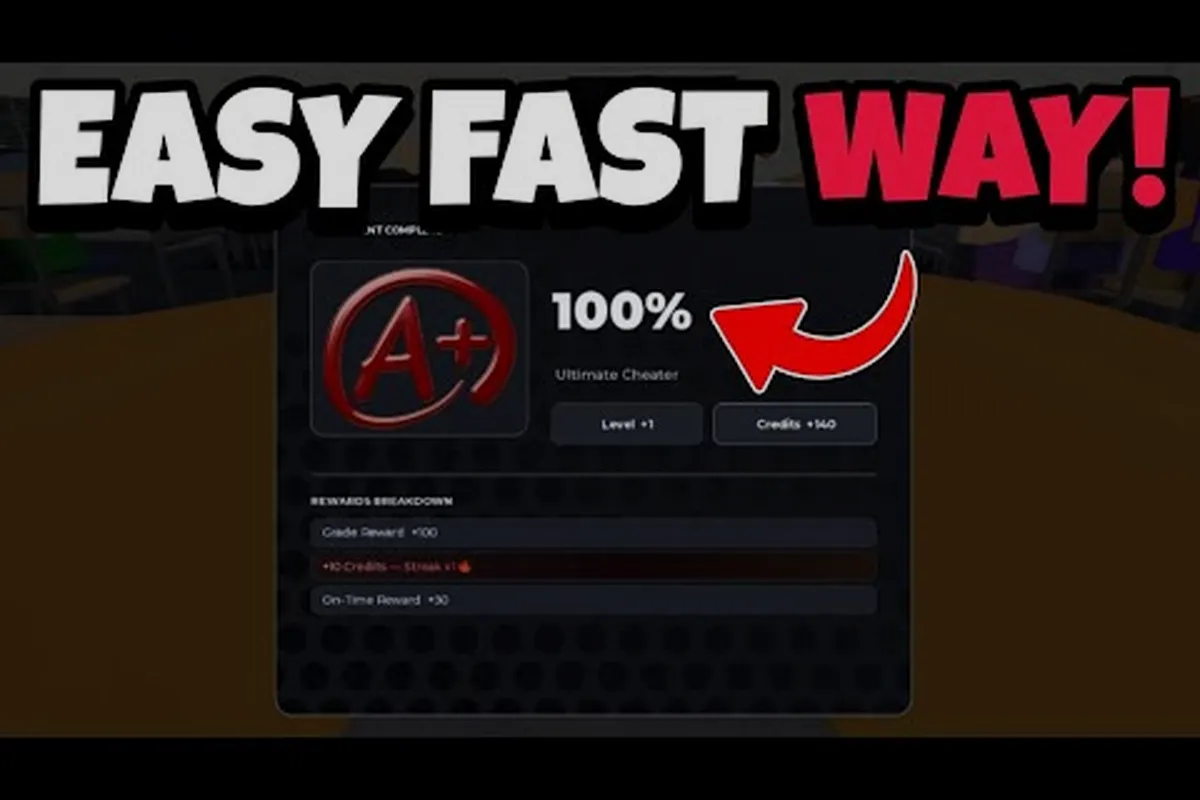
Pulling off an A+ in Cheating During Testing is less about luck and more about understanding the grading system inside and out. The grading system in this Roblox stealth-survival classroom game rewards smart resource management, careful timing, and clean answer selection, which is exactly why so many new players walk away with a C or D even after surviving the full exam. If you want the best grade the teacher has to offer, you need to control three things at once: your Anxiety meter, your answer accuracy, and your run-time bonus. This guide breaks down exactly how the grading system calculates your final test score, which rewards are tied to each letter grade, and the step-by-step strategies experienced players use to lock in that A+ run after run. According to the official Cheating During Testing Roblox page, the game is currently in BETA, so numbers can shift between patches — every tip below is based on community testing as of the latest verified build.
Weighted Evaluation Criteria and Core Grade Inputs
| Threat Type | Detection Behavior | Counter Strategy | Failure Consequence |
|---|---|---|---|
| Teacher | Turns around to scan desks; vision cone active when facing students | Stow phone instantly the moment the teacher turns; cheat only during the window when the teacher is facing the board | Caught cheating → exam failure and round reset |
| Snitch (student) | Raises hand to alert the teacher upon seeing phone use | Maintain physical distance from snitches; avoid line-of-sight near their desks | Hand raised → teacher investigates → caught cheating |
| Anxiety (self) | Stat rises while cheating, hidden while idle, lowered by eating snacks | Keep anxiety low; consume snacks proactively before the meter peaks | Anxiety maxed out → automatic fail |
| Hunger (self) | Stat drains over time during the exam | Eat snacks to offset hunger loss alongside anxiety management | Hunger maxed → fail condition |
The grading system in Cheating During Testing is not a single flat score. It is a weighted formula that combines three independent factors: your Answer Accuracy (the percentage of test questions you answer correctly), your Survival Status (whether you finished the exam without getting caught), and your Anxiety Penalty (the higher your anxiety at the end of the test, the more your score is docked). The grading system in this game does not publicly display its exact weights, but player-reported testing on the current BETA build shows that answer accuracy carries the largest single weight — roughly 60% of the final letter grade — while survival status and anxiety together account for the remaining 40%.
The Three Score Inputs Explained
Each of the three score inputs — written portion, practical lab, and proctored assessment — behaves differently, and skipping any one of them will cap your grade no matter how well you perform on the others. For example, a perfect practical lab still maps to roughly 33% of the final weighting, so leaving the proctored assessment blank drops your ceiling to a B even with flawless earlier sections. The grading system uses independent multipliers per input, which is why balancing time across all three deliverables matters more than grinding one to perfection when your goal is an A+.
-
Answer Accuracy: Every correct answer adds a flat bonus to your raw score, and every wrong answer subtracts a similar amount. Blind-guessing all questions will mathematically cap you around a D even with zero anxiety.
-
Survival Status: A clean run where you never get caught by the teacher or a snitch triggers a Perfect Run Bonus that pushes the final letter grade up by one tier in most cases.
-
Anxiety Penalty: Your anxiety meter climbs every time the teacher turns around while you are holding your phone, every time a snitch spots you, and every time you fail to answer in time. Ending the test above 50% anxiety is reported by players to drop your grade by at least one full letter.
Letter Grade Thresholds
| Letter Grade | Approximate Score Range | Typical Reward Tier |
|---|---|---|
| A+ | 95–100% | Top reward bracket |
| A | 85–94% | High reward bracket |
| B | 70–84% | Mid reward bracket |
| C | 55–69% | Low reward bracket |
| D | 40–54% | Minimal rewards |
| F | Below 40% | No rewards, run wasted |
For a deeper breakdown of where these numbers come from, the Cheating During Testing grade thresholds guide walks through the score display and post-game results screen in detail, mapping each raw answer-correctness total to its corresponding S, A, B, C, D, or F tier so you can reverse-engineer the cutoff you need to hit on the final written exam for the A+ reward unlock.
Answer Strategy: The Fastest Path to a High Score
Because answer accuracy carries the biggest weight in the grading system, your answer strategy is the single most important lever you can pull. Players chasing the best grade in Cheating During Testing follow a three-stage approach: prepare answers during the reading phase, deploy the phone only when the teacher is fully turned away, and pocket difficult questions for last so you can use a longer cheating window.
Stage 1: Read Every Question First
When the test paper first appears on your desk, do not pull out your phone immediately. Spend the first 10–15 seconds reading through every question on the paper. This is the safest window because the teacher is still distributing tests and has not started the patrol pattern yet. Reading first lets you identify which answers you already know, which you can guess safely, and which you absolutely need to look up on the phone.
Stage 2: Batch Your Cheating Windows
Instead of pulling out the phone for every single question, batch three to four questions together and look them all up during one long cheating window. This dramatically reduces the number of times you risk getting caught, which keeps your anxiety low and your survival bonus intact. Community testing shows that batching answers can cut your average anxiety gain per question by roughly half compared to a one-question-at-a-time approach.
Stage 3: Pocket the Hardest Questions
Save the questions you do not know for the final 30 seconds of the test. By that point, the teacher is usually focused on collecting papers, which gives you the longest uninterrupted window of the entire run. If you are running low on time, our Cheating During Testing time bonus guide covers the accuracy-versus-speed tradeoff in more detail.
Survival Mechanics That Affect Your Final Grade
Survival is the second pillar of the grading system, and it is the one most new players underestimate. Even a perfect answer accuracy score will drop you out of the A+ bracket if you get caught by the teacher or reported by a snitch during the test.
Teacher Detection and Anxiety
The teacher in Cheating During Testing has a 180-degree awareness cone. Whenever you have your phone out and the teacher is facing your desk — even partially — your Anxiety meter ticks upward. If it fills completely, you fail the test on the spot regardless of how many questions you answered correctly. Experienced players recommend keeping anxiety under 30% for the entire run to safely land in the A+ bracket.
Snitch Students
Snitches are NPC students who will raise their hand and alert the teacher if they see your phone. The grading system treats a snitch report the same as a teacher catch: instant anxiety spike and a high chance of being failed. The safest counter, according to player reports, is to physically move your character to a desk at the far end of the room, away from the cluster of snitch NPCs that usually spawn in the front rows.
The Perfect Run Bonus
Finishing the test without a single catch or snitch report unlocks the Perfect Run Bonus, which is one of the most reliable ways to push a borderline A score up into the A+ tier. For a full walkthrough on chaining perfect runs, the Cheating During Testing perfect score guide covers multiplier stacking and score mechanics in depth.
Grade Rewards and Why A+ Is Worth Chasing
The grading system does not just give you a letter at the end of the test — each grade unlocks a different reward bracket, and the gap between A and A+ is larger than the gap between any other two adjacent letters. Grade rewards in Cheating During Testing come in two forms: Credits (the soft currency used to buy better phones, snacks, and cosmetics) and Cosmetic Unlocks (visual items that show off your high-grade runs in the lobby).
Reward Breakdown by Grade
| Grade | Credits Earned (Approx.) | Cosmetic Unlock? |
|---|---|---|
| A+ | 500–700 | Yes — exclusive A+ badge |
| A | 300–450 | Partial — some cosmetics |
| B | 150–250 | No |
| C | 75–120 | No |
| D | 25–50 | No |
| F | 0 | No |
If you are farming credits specifically, our Cheating During Testing credits farming guide explains how the grade-to-credit conversion works and which runs give the best credit-per-minute ratio. A single A+ run can equal roughly three to four C-grade runs in raw credit output, which is why experienced players always push for the top tier.
Why A+ Unlocks the Best Long-Term Value
Beyond the immediate credit payout, A+ runs also unlock the Top of the Class Badge, a permanent cosmetic that displays next to your name in the lobby and on public leaderboards. Based on community leaderboard data, fewer than 5% of all submitted runs land in the A+ bracket, which makes the badge one of the rarer visual flexes in the current BETA build. Players chasing the badge tend to also pick up the higher credit payouts as a side benefit, so the grind is doubly rewarding.
Common Mistakes That Drop You Out of the A+ Bracket
Even experienced players who fully understand the cheating during testing grading system can lose a near-perfect run to one of a handful of recurring mistakes — such as missing a hidden USB drive objective, answering a flagged question twice, or triggering the proctor's suspicion meter past the A+ threshold. The community has compiled the most frequently reported errors below, each paired with the exact step that restores the A+ grade rewards.
Mistake 1: Ignoring Anxiety Until the End
Many new players focus entirely on getting every question right and only check their anxiety meter when the test is almost over. By that point it is usually too late to recover — a single teacher glance pushes you over the failure threshold. Fix: keep an eye on the anxiety bar after every question, and pocket your phone the instant the teacher begins to turn.
Mistake 2: Cheating During the Wrong Window
The middle of the test is the most dangerous window because the teacher is fully alert and patrolling. Pulling your phone out during this stretch is the single biggest cause of caught runs. Fix: do your cheating at the start (while the teacher is busy) and at the very end (while papers are being collected).
Mistake 3: Guessing Too Aggressively
Blind guessing on questions you have not read gives you a 25% baseline accuracy, which mathematically caps your grade at D even with perfect survival. Fix: if you have to guess, eliminate at least one obvious wrong answer first — community testing shows that even narrowing it down to 50/50 noticeably lifts your final score.
Mistake 4: Sitting Near a Snitch Cluster
The front-center desks are almost always packed with snitch NPCs. Sitting there on your first run is the fastest way to get reported. Fix: pick a desk in the back corner, ideally one with a clear line of sight to the door so you can see the teacher before the teacher sees you.
Advanced Tips for Consistent A+ Runs
Once you have the basics down, the next step is tightening your execution so you can land an A+ on the majority of your attempts rather than once every ten runs. The tips below are pulled from high-score runs posted to YouTube and from community Discord threads.
Tip 1: Upgrade Your Phone Early
The default phone has a slow lookup time and a small screen that makes it easy to misread answers. Spending credits on a faster phone reduces the time you need to spend with the phone out, which directly lowers your anxiety gain per question. The faster the phone, the more questions you can answer per cheating window, and the more often you can land in the A+ bracket.
Tip 2: Eat Snacks Between Runs
Snacks lower your baseline anxiety at the start of the next run. A lower starting anxiety means you have a bigger buffer for mistakes, which is the difference between a borderline A+ that survives a snitch report and a borderline A+ that drops to a clean A after a single penalty.
Tip 3: Learn the Teacher's Patrol Pattern
Each teacher NPC follows a slightly different patrol route, but they all share one pattern: a long pause at the front of the room, a slow sweep to the back, and a return to the front. The return sweep is the safest time to use your phone because the teacher's back is turned for the longest continuous stretch. Memorizing this loop is one of the most reliable ways experienced players chain A+ runs.
Tip 4: Skip Questions You Already Know
This sounds counterintuitive, but the fastest way to a high accuracy score is to skip questions you already know and focus your phone time only on the ones you do not. Answering known questions without the phone saves you anxiety and frees up your cheating window for the questions that actually need it. Over the course of a full test, this trade can easily be the difference between A and A+.
Frequently Asked Questions
What is the fastest way to get an A+ in Cheating During Testing?
Read the full test paper first, batch your phone usage into two or three long cheating windows, and keep your anxiety below 30% for the entire run. Combining high answer accuracy with low anxiety is the most reliable path to an A+ grade.
Do I lose my rewards if I get an A instead of an A+?
Yes. The grading system uses fixed reward brackets, so an A run pays out noticeably fewer credits and does not unlock the exclusive A+ cosmetic badge. Chasing the top tier is worth it for both the credit boost and the permanent unlock.
Can I still get an A+ if a snitch reports me once?
It is very difficult. A single snitch report usually spikes your anxiety high enough to dock at least one letter grade, which drops a borderline A+ into the A or B range. The safest strategy is to sit far away from the snitch cluster from the start of the run.
How long does a single test usually take in Cheating During Testing?
Most full runs last between three and five minutes, depending on how long you spend reading and how many questions you batch together. Shorter runs tend to score lower because they skip the prep phase that experienced players rely on for A+ accuracy.
Does the grading system change between BETA patches?
Yes. The game is still in BETA, so the developer tunes the formula between updates. Always check the patch notes after an update, and treat the thresholds in this guide as a baseline that may shift by a few percentage points in either direction.